As employers in the Philippines, we carry the vital responsibility of ensuring compliance with the Bureau of Internal Revenue (BIR) regulations. Understanding which BIR forms for employers to file—and when—is essential to avoid penalties, maintain accurate payroll records, and ensure seamless tax reporting.
This comprehensive guide from GreatDay HR will walk you through every key BIR form, filing schedule, and compliance process for 2026.
1. Why BIR Compliance Matters for Employers
Every registered employer in the Philippines must withhold income tax from employee salaries and remit it to the BIR on time. These filings prove that your company complies with government tax laws and supports accurate employee taxation records.
Neglecting to file or submit BIR forms correctly may result in costly surcharges, interest, and potential audits. For a growing company, this can disrupt operations and erode employee trust—making proper compliance essential for smooth payroll management.
2. Employee Registration and Information Updates
BIR Form 1902 – Registration for New Employees
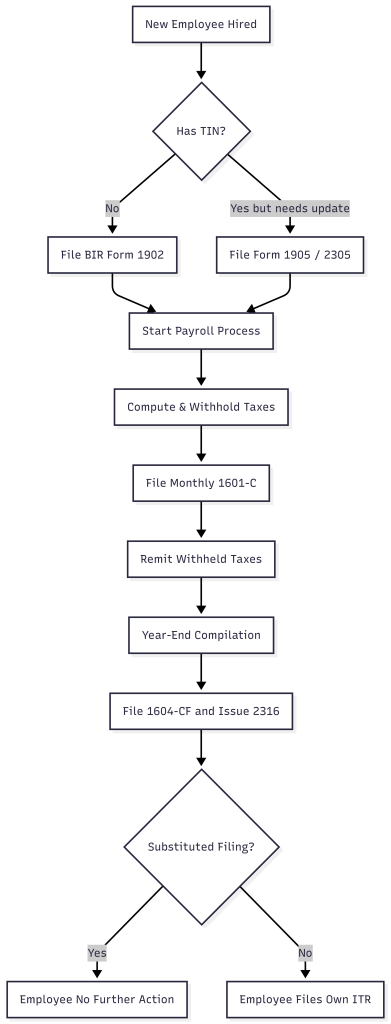
When you hire a new employee, you must register them with the BIR using Form 1902. This ensures they are recorded under your company’s Revenue District Office (RDO).
BIR Form 1905 – Updating or Transferring Employee Information
When employees change address, RDO, or other registration details, employers must file Form 1905 to ensure BIR records remain accurate.
BIR Form 2305 – Updating Employee Exemptions or Dependents
Employees who change marital status, number of dependents, or exemption claims should file Form 2305 to update their tax profile.
These registration updates are vital for computing the correct withholding tax and avoiding mismatched BIR data during audits.
3. Monthly and Quarterly Withholding Forms
BIR Form 1601-C – Monthly Remittance Return of Taxes Withheld on Compensation
Employers must file Form 1601-C every month to declare and remit income tax withheld from employee salaries.
- Deadline: On or before the 10th day of the following month.
- Zero Withholding: Even if no tax is withheld, employers must still file to show compliance.
BIR Form 1601-EQ – Quarterly Remittance Return
In specific cases, employers file Form 1601-EQ for quarterly reporting of expanded withholding taxes.
BIR Form 1604-E / 1604-CF – Annual Information Return
At the end of the fiscal year, Form 1604-CF consolidates all compensation-related withholdings for submission to the BIR.
These forms serve as official records of all employee compensation taxes withheld throughout the year.
4. Year-End Employee Certificates
BIR Form 2316 – Certificate of Compensation and Tax Withheld
By January 31 of the following year, employers must issue Form 2316 to all employees. This document serves as proof of income and taxes withheld during the previous year.
Employees must sign and return a copy for employer filing. Failure to issue or collect signed 2316 forms can invalidate substituted filing privileges and create reporting discrepancies.
BIR Form 1604-CF – Annual Summary
Employers then compile all Form 2316 data and submit it through Form 1604-CF, due by January 31.
5. Substituted Filing Explained
Employees who receive income from only one employer and whose taxes were withheld correctly throughout the year can use substituted filing. In this case, Form 2316 serves as their annual income tax return.
If an employee works for multiple employers or earns additional income, they must file their own ITR instead.
6. BIR Filing Deadlines Summary
| BIR Form | Purpose | Filing Frequency | Deadline |
| 1902 | Register new employees | As needed | Upon hiring |
| 1905 / 2305 | Update employee info | As needed | As required |
| 1601-C | Monthly tax withholding | Monthly | 10th of following month |
| 1601-EQ | Quarterly withholding | Quarterly | Last day of following month |
| 1604-CF | Annual tax summary | Yearly | January 31 |
| 2316 | Employee tax certificate | Yearly | January 31 |
7. Penalties and Common Employer Mistakes
- Late Filing or Remittance: Subject to 25% surcharge and interest.
- Incorrect Employee Information: Leads to mismatched BIR records.
- Failure to Issue Form 2316: Disqualifies employees from substituted filing.
- Skipping Zero Returns: Even if no tax is withheld, the BIR still requires filing for that month.
Avoiding these mistakes protects your company from unnecessary audits and compliance risks.
8. Simplify BIR Compliance with GreatDay HR
Managing all these forms manually can be time-consuming. GreatDay HR offers an integrated Managed Payroll Service that automates your BIR filings, payroll calculations, and employee record updates—ensuring 100% compliance without the stress.
With GreatDay HR, you can:
- Automatically generate and file BIR Forms 1601-C, 1604-CF, and 2316.
- Keep employee records (1902, 2305, 1905) updated in one system.
- Track payroll changes and deadlines in real-time.
- Get expert support from local HR and payroll professionals.
Learn more about the Managed Payroll Service and discover how it can save time, reduce errors, and ensure worry-free BIR compliance for your business.
9. BIR Form Workflow Diagram
10. Final Thoughts
Compliance with BIR regulations doesn’t need to be complicated. By understanding which forms to file and when — and by using modern payroll technology — you can avoid costly penalties and ensure smooth HR operations.
With GreatDay HR and its Managed Payroll Service, employers gain a reliable partner in automating payroll processes and tax filings, ensuring every form is accurate, timely, and compliant.
Make every payday a GreatDay with efficient, compliant, and worry-free payroll management.